


For the maintenance and cleaning of historic buildings, churches and surrounding outdoor areas, it is essential to rely on professional solutions that effectively remove dirt while protecting surfaces.
Thorough cleaning is an important part of building maintenance and helps preserve their historical and architectural value, with particular attention to delicate elements such as stone, plaster, sculptures and bas-reliefs.
When maintaining historic and religious buildings, professional high-pressure cleaners can be an effective solution, provided that the pressure, distance and accessories are suitable for the surface being cleaned. Thanks to their versatility and adjustable water jet, these machines can tackle different types of dirt while reducing cleaning times.
High pressure cleaners can also be used for cleaning outdoor paving, cloisters, stairways, church forecourts, courtyards and green areas, always selecting methods and accessories compatible with the materials involved.
Let's explore how to use a high-pressure cleaner to clean historic buildings, churches and green areas, along with the precautions to take and how to choose the most suitable model for each application.
How to clean historic buildings and churches with a high-pressure cleaner
Professional high-pressure cleaners use a high-pressure water jet to remove dirt, dust and residues from surfaces, often reducing water consumption and the need for cleaning detergents.
Thanks to their design, the wide range of available accessories and the possibility of adjusting the water jet, they can also be used for the maintenance of historic buildings and churches.
In these environments, it may be necessary to remove dust, pollution deposits, mould, moss and encrustations, while avoiding excessive pressure on plaster, stone and decorative elements.
For this reason, when using a high-pressure cleaner on historic or particularly delicate surfaces, it is essential to adjust the pressure correctly, maintain a suitable distance and check that the cleaning method is compatible with the material.
For surfaces of particular historical value or protected heritage buildings, it is advisable to have the cleaning procedure assessed by qualified conservation professionals beforehand.

How to use a high-pressure cleaner without damaging surfaces
To achieve effective cleaning results while protecting historic buildings and churches, it is important to follow a few precautions:
- Test the high-pressure cleaner on a small, preferably hidden area to check how the surface reacts to the water jet.
- Maintain a suitable distance from the surface to prevent the water pressure from damaging delicate areas.
- Adjust the pressure and spray pattern according to the material being cleaned.
- Choose the right accessory based on the surface and the type of dirt to be removed.
- Perform regular high-pressure cleaner maintenance to ensure proper operation and safe use.
When removing moss and weeds from joints between stone surfaces, a more concentrated water jet may be useful, provided its effect is tested beforehand.
For large, uniform surfaces, an adjustable fan spray lance distributes water over a wider area, helping to speed up cleaning operations.
What can you clean with a high pressure cleaner in churches and historic buildings?
In addition to walls and façades, a high-pressure cleaner can be used, when the surface allows it, to clean:
- Outdoor floors and paving
- Cloisters
- Stairways
- Church forecourts
- Courtyards
- Stone surfaces
- Brickwork
- Terracotta paving
- Stone slabs and other durable outdoor surfaces
Thanks to the possibility of replacing lances, spray guns and nozzles with specific accessories, the machine can be adapted to different cleaning requirements.
Using a single professional cleaning machine makes it possible to maintain several areas of a building while reducing cleaning time, physical effort and water consumption compared with certain traditional cleaning methods.
Cleaning and restoring historic buildings with wet sandblasting
In addition to periodic cleaning to remove mould, moss and encrustations, some Lavor high-pressure cleaners can be equipped with specific accessories for more intensive cleaning operations.
One of the techniques used to remove graffiti, stubborn dirt and old coatings is wet sandblasting.

By equipping certain Lavor professional high-pressure cleaners, such as the HTR, with a wet sandblasting lance, it is possible to combine the cleaning action of water with an abrasive material.
The abrasive material must be selected according to the surface being treated:
- Silica sand: suitable for more aggressive cleaning operations and therefore requiring particular care during use.
- Sodium bicarbonate: less aggressive and more suitable when a gentler abrasive action is required.
The compatibility of this technique with historic, wooden, painted or particularly delicate surfaces must always be checked before use.
High pressure cleaners can also be used with specific lances and nozzles for more targeted cleaning operations, such as:
- Removing dust, mould, residues, wax, grease and old coatings, when the surface material allows it.
- Removing loose or flaking paint using a gentle, controlled water jet.
The versatility of Lavor professional high-pressure cleaners makes it possible to adapt each cleaning operation to the type of dirt, surface material and desired result.
How to clean green areas around churches and historic buildings with a high-pressure cleaner
Maintaining historic and religious buildings often also involves taking care of the surrounding green spaces and outdoor areas, including:
- Parks
- Gardens
- Courtyards
- Pathways
- Flower beds
- Cemetery grounds
Tiles, plant pots, paving, low walls, railings and outdoor furniture are made from different materials and require specific cleaning methods.
In these environments, high-pressure cleaners offer a fast and targeted cleaning solution.
Compared with a conventional garden hose, the pressurised water jet concentrates its cleaning action where needed, making it easier to remove moss, mould, lichen, soil and dirt from pathways, courtyards, benches, low walls and other resistant surfaces.
By adjusting the water jet appropriately, high pressure cleaners can also be used on stone, wood and brick, provided that the pressure and distance are suitable for the material.
A high pressure cleaner can therefore also be used to maintain outdoor features such as statues, fountains and gravestones, as long as their condition and surface characteristics allow this type of cleaning.

Which high pressure cleaner should you choose for historic buildings and large outdoor areas?
When choosing a high pressure cleaner for historic buildings, churches and green areas, several factors should be considered:
- Frequency of use
- Size of the area to be cleaned
- Type of dirt
- Surface material
- Accessories required
- Water pressure needed
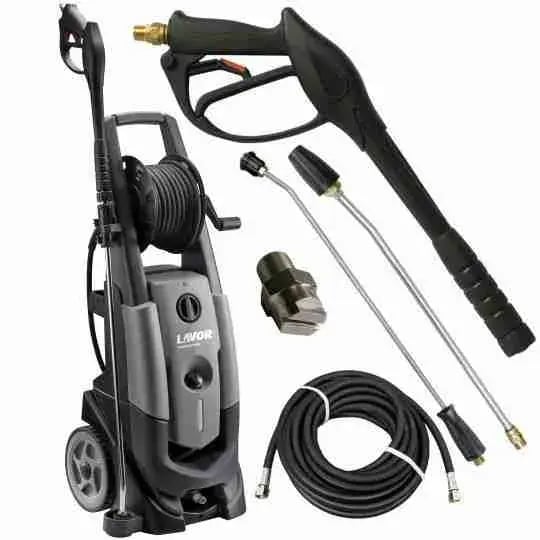
Among the Lavor professional models, the HKA is suitable for frequent use, removing particularly stubborn dirt and cleaning medium-sized surfaces.
Thanks to its axial pump with brass head, it can be an effective solution for maintaining large outdoor areas and buildings that require frequent professional cleaning.
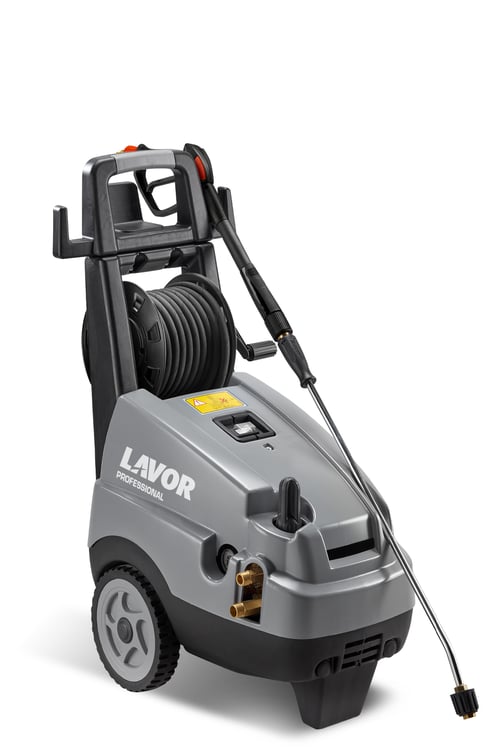
For larger surfaces, Lavor also offers the HNR, designed for intensive use and the removal of particularly stubborn dirt.
Its 4-pole electric motor operating at a low speed of 1,450 RPM, together with the water-cooling system, is designed to support prolonged professional use.
The HNR also features an in-line pump with ceramic-coated pistons and a nickel-plated brass head with high-temperature seals.
Using accessories such as pipe cleaning hoses, the HNR can also be employed to clean drains, gutters and drainage systems. Its compatibility with a wet sandblasting lance further extends its range of applications.
By choosing the most suitable high-pressure cleaner and accessories, it is possible to organise the professional cleaning of historic buildings, churches and surrounding outdoor areas more efficiently, adapting each operation to the surface being treated.
FAQ – Cleaning historic buildings and green areas with a high pressure cleaner
Can you use a high pressure cleaner to clean a historic building?
Yes, a high pressure cleaner can be used on certain surfaces of historic buildings, provided that the pressure, distance and spray pattern are suitable for the material. It is always advisable to test the water jet on a small, hidden area first. For particularly valuable or protected historic surfaces, professional conservation advice is recommended.
What pressure should you use to clean a historic building façade?
There is no single pressure setting suitable for every historic façade. The correct pressure depends on the material, its condition and the type of dirt. It is advisable to start with a gentle water jet and increase the pressure only after checking how the surface reacts.
What types of dirt can a high pressure cleaner remove from outdoor walls and paving?
Depending on the surface and pressure settings, a high pressure cleaner can help remove dust, atmospheric dirt, moss, mould, lichen, soil and certain types of encrustations.
Can you use a high pressure cleaner on stone and brick surfaces?
Yes, but the cleaning method must be adapted to the type and condition of the stone or brick. Porous, fragile or deteriorated materials require lower pressure and a greater cleaning distance.
Can high pressure cleaners be used to clean cloisters, church forecourts and stairways?
Yes. When the materials allow it, high pressure cleaners can be used to clean cloisters, church forecourts, courtyards, stairways and outdoor paving, using the most suitable spray pattern and accessories.
Are high pressure cleaners suitable for cleaning green areas?
High pressure cleaners can be used to clean surfaces and structures within green areas, including pathways, paving, low walls, benches, fences and outdoor furniture. However, the water jet should not be directed indiscriminately at plants, soil or delicate features.
What is wet sandblasting with a high pressure cleaner?
Wet sandblasting is a cleaning technique that combines a pressurised water jet with an abrasive material to remove stubborn dirt, graffiti or old coatings. It requires specific accessories and must be used with particular care on delicate surfaces.
Which Lavor high pressure cleaner should you choose for historic buildings and large surfaces?
The choice depends on the frequency of use, the size of the area and the type of cleaning required. Among Lavor's professional solutions, the HKA is suitable for frequent use and medium-sized surfaces, while the HNR is designed for intensive use and larger areas.